
For the Romantic in All of Us…
For the Romantic in All of Us…
There’s a particular quality to the light in military towns that I’ve never seen replicated anywhere else. Maybe it’s the way it falls across base housing, illuminating identical beige homes that somehow contain vastly different stories of loss, hope, and endurance. Or perhaps it’s how that same light catches the faces of women gathered in living rooms, school pickup lines, and commissary aisles—women bound together by an invisible thread of shared understanding that civilian friends, no matter how well-meaning, can never quite grasp.
This is the story of the unspoken sisterhood, the women who learn to read deployment countdowns in each other’s eyes and find strength in the spaces between words.
In military towns, women become fluent in a language that has no formal instruction manual. They learn to decode the weight behind “How are you holding up?” and master the art of the encouraging text sent at 2 AM when insomnia hits and the house feels too quiet. They understand that “Let me know if you need anything” isn’t just politeness—it’s a lifeline thrown across the churning waters of uncertainty.
Sarah, whose husband deployed three times in five years, once told me she could identify other military wives in civilian spaces by the way they carried their phones. “Always face-up, always within reach,” she said, “like a talisman.” There’s a hypervigilance that comes with loving someone whose job description includes danger, and these women recognize it in each other instantly.
The friendships that form in this environment are forged in a crucible that civilian relationships rarely experience. When your husband is in harm’s way on the other side of the world, the woman who brings you dinner without being asked becomes more than a neighbor—she becomes family.
Military towns are built on temporary foundations, both literally and figuratively. Families cycle through every two to four years, yet somehow, the support networks endure. It’s as if each departing woman leaves behind a template: This is how you help. This is what works. This is what matters.
The newcomers are absorbed into this system with surprising speed. Maria, fresh from her husband’s first assignment, described her initiation: “Three days after we moved in, there was a knock on my door. This woman I’d never met was standing there with a casserole and a list of phone numbers. ‘Emergency contacts,’ she said. ‘Not for your husband—he has his chain of command. These are for you.'”
The list included everything from 24-hour childcare for hospital emergencies to someone who could pick up kids from school during a family crisis. But more than logistics, it represented something deeper: proof that she wasn’t alone in this strange new world where normalcy hung suspended between homecomings and departures.
Deployment schedules govern everything in military towns. Social calendars, children’s activities, even grocery shopping patterns shift around the rhythm of who’s here and who’s gone. The women left behind develop their own calendar—marking time not just in months, but in milestones survived: first month down, halfway point, final stretch.
They become experts at managing the peculiar grief of missing someone who isn’t gone forever, just gone for now. It’s a unique form of suspended animation, made bearable only by others who understand that “fine” can mean anything from genuinely okay to barely hanging on.
Jessica, whose husband served four deployments, learned to read the subtle signs: “When someone starts reorganizing their entire house for the third time, they need company. When they mention their kids are being ‘difficult,’ they need a babysitter. When they say everything’s ‘great,’ they definitely need wine and someone to listen.”
The kids in military towns carry their own version of this strength. They adapt to new schools with practiced ease, form friendships quickly, and say goodbye without making promises to stay in touch forever. They understand, in ways that would break adult hearts, that some connections are meant to be brief but meaningful.
But it’s the mothers who bear the weight of maintaining stability for these children while managing their own fears and loneliness. They become actresses, playing the role of the strong, capable wife and mother while privately struggling with sleep problems, anxiety, and the exhausting work of being everything to everyone while their partner is away.
The sisterhood recognizes these performances and offers something invaluable: spaces where the masks can come off. Play dates become therapy sessions. Coffee morning turns into strategy meetings for survival. Birthday parties double as wellness checks.
This community operates by unwritten rules that everyone seems to understand intuitively:
Never ask specifics about missions or locations. Never make someone explain why they can’t commit to long-term plans. Always assume someone might need help, even if they haven’t asked. Take the casserole, even if your freezer is full. Share information about spouse clubs, good doctors, reliable babysitters. Include the new family in everything until they find their footing.
Most importantly: respect the silence when someone can’t talk about what they’re going through. Sometimes the greatest gift is simply existing in the same space, folding laundry while someone else stares out the window.
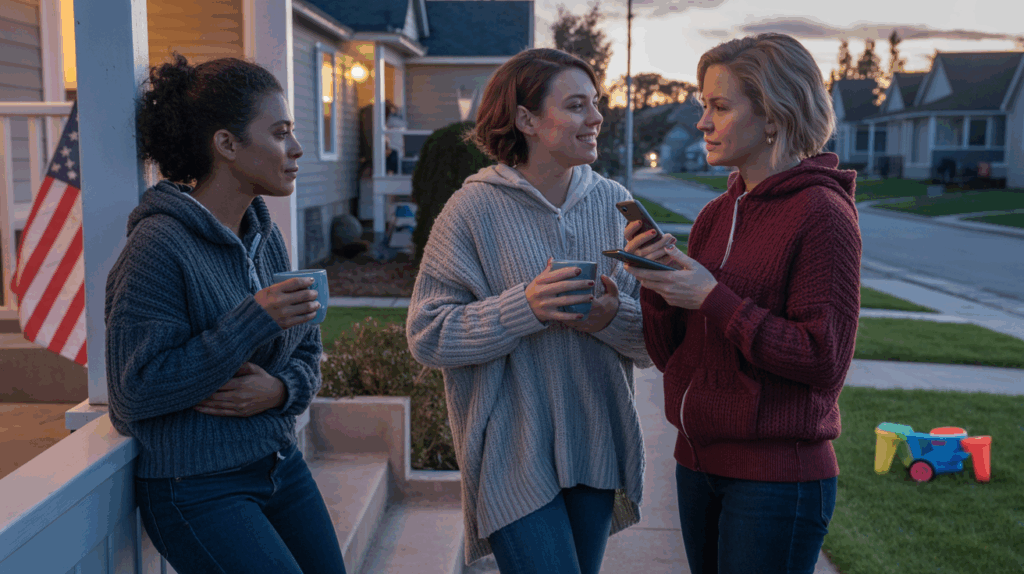
The stories shared in this sisterhood aren’t always dramatic. Often, they’re mundane moments made significant by context: the triumph of assembling furniture alone, the crisis of a broken water heater during deployment, the small victory of a child’s successful school adjustment. These women celebrate each other’s everyday heroics because they understand the weight of maintaining normal life under extraordinary circumstances.
They also share the darker moments—the nights when fear overwhelms rationality, the frustration with well-meaning civilians who suggest they “knew what they signed up for,” the guilt of having needs and feelings when their spouse is in danger. These confessions, shared in kitchen conversations and late-night texts, don’t seek solutions. They seek witness.
What strikes outsiders most about military communities is how help appears seemingly from nowhere. A wife goes into labor early, and within hours, her other children are being cared for, her house is clean, and meals appear in her refrigerator. A family receives devastating news, and the practical details of life are quietly managed by hands they may not even recognize.
This network operates with the efficiency of any military operation, but it’s powered entirely by empathy and shared experience. Phone trees activate without formal leadership. Resources appear without bureaucracy. Problems get solved through collective action that looks effortless but represents countless individual decisions to show up for each other.
This sisterhood isn’t without its complexities. The pressure to appear strong and supportive can become its own burden. Women worry about being judged for struggling, for needing too much help, for not adapting quickly enough. The competitive undercurrent about whose sacrifice is greater, whose deployment is harder, whose husband has the more dangerous job, can create tensions that fracture relationships.
There’s also the exhaustion of being strong for everyone else while managing your own fears and needs. Some women burn out from caregiving, others isolate themselves rather than risk appearing weak. The sisterhood is only as strong as its individual members, and sometimes those members are running on empty.
Perhaps the most remarkable aspect of this community is how it extends beyond official military structures. These women create their own institutions: informal childcare cooperatives, emergency contact networks, mentorship systems that pair experienced wives with newcomers. They establish traditions—welcome baskets, deployment send-offs, homecoming celebrations—that create continuity in an environment defined by change.
When families move on to new assignments, they carry these systems with them, replicating support networks at each new base. Former neighbors stay connected across continents, offering advice about new duty stations and maintaining friendships that span decades and multiple time zones.
Reunion brings its own challenges that the sisterhood helps navigate. The fantasy of homecoming rarely matches reality—both partners have changed during separation, children have grown and adapted to single-parent routines, and reintegration requires patience and grace that popular culture rarely acknowledges.
The women who’ve been through multiple deployments become guides for these transitions, normalizing the difficulty of rediscovering your partnership and family dynamics. They understand that homecoming isn’t an ending—it’s another beginning, with its own learning curve and need for support.
Military towns change with each PCS season, but the spirit of the sisterhood endures. The specific faces may rotate, but the commitment to supporting each other remains constant. New wives inherit a legacy of women who’ve faced uncertainty with grace, who’ve found ways to thrive in temporary situations, and who’ve proven that families can be created from shared experience as much as from blood or marriage.
This isn’t a story of victimhood or sacrifice, though both exist in military life. It’s a story of resilience, adaptability, and the profound human capacity to create meaning and connection under challenging circumstances. It’s about women who’ve learned that strength isn’t a solo performance—it’s a collective act of courage, witnessed and supported by others who understand the cost.
In military towns, the light still falls the same way across identical houses. But inside those homes, extraordinary women continue writing stories of endurance, friendship, and quiet heroism. They’re the unspoken sisterhood of waiting, but they’re also the visible network of women who refuse to wait alone.
The next time you find yourself in a military community, look for the signs: the quick conversations at school pickup, the way women’s eyes meet across commissary aisles, the phone calls that happen during children’s nap times. You’ll witness the daily operation of one of the strongest, most adaptive communities in America—one that understands that true strength is never a solitary achievement.
Thanks for reading!
Ready for your next book boyfriend or edge-of-your-seat thriller? Check out my complete collection of stories.
~ Erosa